
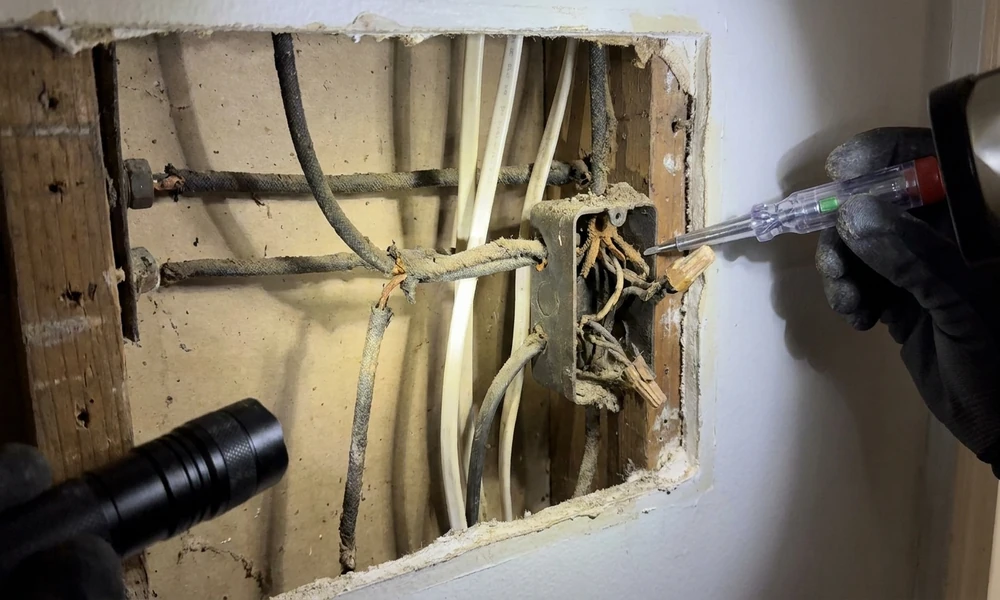

Archaeologists read the past in layers. The deeper the dig, the older the story. A house works the same way. Behind the drywall, wiring was installed according to the rules and materials of its day, and later owners added their own layers on top. A kitchen remodel in one decade, a finished basement in another, a few outlets added by a handy relative somewhere in between.
You can learn a lot about what might be hiding in your walls just by knowing when the house was built. This article digs through the common eras of residential wiring and describes what an electrician tends to look for in each. It is general information, not an inspection of any particular home, and every house deserves its own evaluation.
The Deepest Layer: Homes From Before the 1950s
Very old houses may still contain knob and tube wiring, a system where individual conductors ran through the framing on ceramic supports and tubes. It was a reasonable design for its time, and in good condition it can still function. The trouble is what has happened around it since.
Knob and tube was designed to release heat into open air. When insulation gets blown into attics and wall cavities over it, that heat has nowhere to go. Insulation contact is one of the main concerns electricians raise. Another is age, since the rubber and cloth coverings on old conductors can become brittle and crack. And because the system has no grounding conductor, it cannot support modern three-prong devices safely, which leads to the next common problem: adapters and workarounds added over the years.
What an electrician looks for in this era:
- Original wiring that was spliced into by later additions
- Insulation packed around old conductors
- Overloaded circuits serving far more devices than the house was designed for
- Fuse panels where oversized fuses have replaced the correct ones
The Middle Layers: The 1950s and 1960s
Homes from the postwar decades generally used sheathed cable with better insulation, a big step forward. Many still have ungrounded outlets, the old two-slot style, which cannot divert a fault safely. Owners often swap these for three-prong receptacles without adding the missing ground, which makes the outlet look modern without making it safe.
Panels in this era were small by today’s standards, often sized for a time when a house ran a few lights, a refrigerator, and a television. A 1960s house running central air, a microwave, and a home office may be asking a lot of a system that was never meant to carry it.
The Controversial Layer: The Mid 1960s to the Late 1970s
During a period when copper prices rose, some builders used aluminum branch circuit wiring. Aluminum is a perfectly good conductor, but it behaves differently from copper. It expands and contracts more with temperature, and it can oxidize at connections, which may loosen them over time and create heat.
The U.S. Consumer Product Safety Commission has published guidance on aluminum branch circuit wiring and its risks, and homeowners with houses from this era benefit from learning whether theirs is affected. Its safety resources are a starting point for understanding home hazards of this kind. Remedies exist, and they are specific. A licensed electrician can identify aluminum wiring and recommend approved repair methods, which is not an area for improvisation.
This era is also when certain panel brands were later flagged by safety researchers and industry for reliability concerns. If your home is from these decades, ask an electrician to look at the panel’s make and condition rather than assuming it is fine.
The Modernizing Layer: The 1980s and 1990s
Homes from this stretch typically have copper wiring, grounded outlets, and larger panels. They are generally in better shape, but they have their own quirks. Builder grade materials were common, and a house now thirty or forty years old has seen a lot of use. Outlets may be worn and loose, connections may have loosened with age, and the safety devices that are standard today were often not required yet.
This is also the era when homes began carrying more electronics, which stretches circuits that were laid out for a simpler lifestyle. Bathrooms and kitchens may lack the dedicated circuits and protection that current practice favors.
The Newest Layer: Homes From the 2000s Onward
Newer homes benefit from modern codes, which now call for ground fault protection in wet and damp locations and arc fault protection on many living area circuits. Panels are larger, wiring is copper, and grounding is standard. These houses are not immune to problems, though. Builders cut corners sometimes, and the remodel layers added by later owners can introduce mistakes.
An older house with a recent renovation is really two houses in one. New circuits can be tied into aging wiring in ways that create hidden weak points, which is why electricians often ask not just when the home was built but what has been done to it since.
The Layer Nobody Planned: DIY and Past Repairs
Every home has this one. Open a few junction boxes and you may find mismatched wire, splices outside of boxes, tape where a connector belongs, or circuits extended to serve a room that was never in the original plan. These are not always dangerous, but they are always worth knowing about.
An evaluation should include a look at the quality of past work, not only the original installation. Clues from the outside include outlets that spark or feel warm, switches that crackle, lights that dim when appliances start, breakers that trip or will not reset, and a faint burning smell. Any of these deserves prompt professional attention.
What a Good Evaluation Covers
A thorough look at an older home usually includes the service size and condition, the panel and its brand and protective devices, grounding and bonding, a sampling of outlets and switches, a check for aluminum or knob and tube wiring, attic and basement visual inspection, and a conversation about what you plan to add. A buyer considering an older house can ask for this before closing, which is often cheaper than discovering problems afterward.
If you are looking for local help, you could contact an electrician in Elk Grove to ask about an evaluation and what they would check in a house of your age. Bring along anything you know about the home’s history, such as permits, past renovation records, and the approximate year of construction. Those details help a professional know where to dig first.
Elk Grove is the name of more than one community in the United States, and local codes differ, so ask any contractor about the rules in your jurisdiction.
The Takeaway
Every house is a stack of decades, and the wiring inside it carries the habits and limits of the time it was installed. Knowing roughly when your home was built tells you which questions to ask and which risks to keep in mind. You do not need to fear old wiring, but you do need to know what you have. A careful look from a licensed professional turns a mystery behind the walls into a clear list of facts, and facts are what let you decide what to fix, what to monitor, and what to leave alone.