
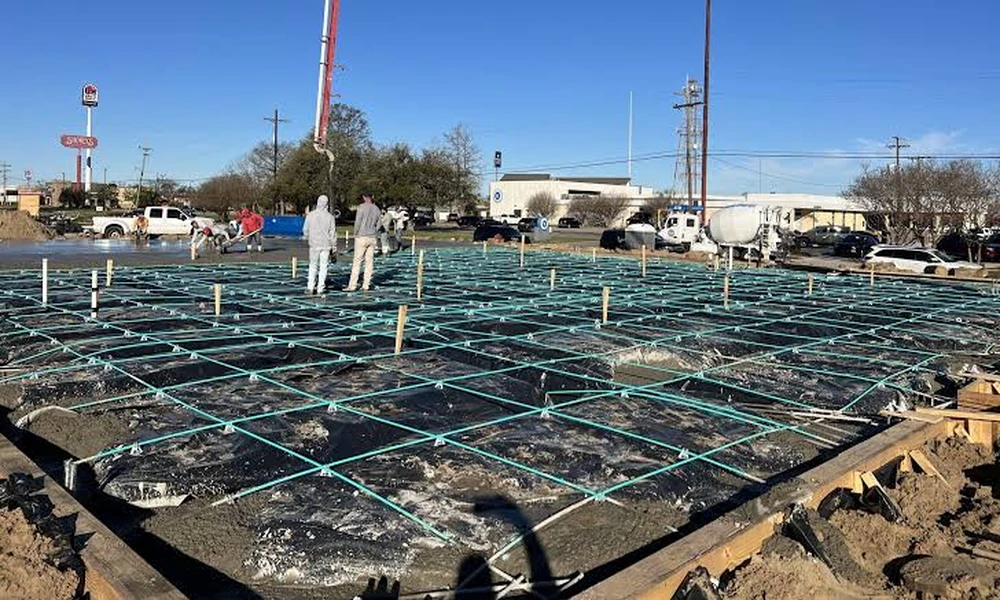

Pick the wrong foundation for South Louisiana’s ground and you’re not just staring at hairline cracks down the road. You’re staring at doors that won’t close, tile that pops off grout lines, and a repair bill that can dwarf what the upgrade would have cost on day one. The soil below Baton Rouge, Prairieville, and the surrounding parishes is not neutral terrain. It moves, and whatever you pour on top of it has to move intelligently or fight back with engineered force.
This article breaks down the real structural differences between a conventional slab-on-grade and a post-tension slab, explains why South Louisiana’s soil profile makes that choice more consequential than almost anywhere else in the South, and gives you a straightforward framework for deciding which system belongs under your next build.
The Ground Beneath Your Slab Is the Actual Problem
Most foundation conversations start with concrete. The smarter conversation starts six inches below the surface. South Louisiana sits on some of the most active clay soil in the country, soil that swells when saturated and contracts when it dries. That constant moisture cycling is the enemy of rigid structures.
Drying and wetting of expansive soils cause shrinkage and swelling, which are the source of many problems for lightweight structures due to creating significant differential movements in building foundations. In the Gulf Coast climate, where a wet spring can be followed by a brutal July drought, that cycle runs hard every single year. Volume expansions of ten percent or more are not uncommon, and that change in volume can exert enough force on a building or other structure to cause serious damage.
This is not a peripheral risk. The American Society of Civil Engineers has estimated that as many as one in four houses in the United States has some form of damage caused by expansive soils, according to data reported by Geology.com, which publishes geologic hazard education sourced from USGS research. In high-clay parishes, that number skews considerably higher.
So the question of slab type isn’t really about concrete preference. It’s about which reinforcement strategy matches the ground you’re building on.
Conventional Slab-on-Grade: When It Works and When It Doesn’t
A conventional slab-on-grade uses a uniform thickness of concrete reinforced with rebar or wire mesh. The footing runs along the perimeter, the slab sits on top of compacted fill, and the system distributes the building’s load outward and downward through sheer mass and steel.
On stable, well-drained soil, that’s a perfectly sound approach. It’s cost-predictable, widely understood by local subcontractors, and straightforward to inspect. The problem is that South Louisiana’s soil is rarely stable in the sense that matters to a foundation engineer. When the clay underneath a conventional slab contracts during a dry spell, sections of the slab lose bearing support unevenly. The perimeter stays supported longer than the center, and the slab begins to dome. That differential movement is what causes the cracked tile and racked doorframes that homeowners associate with “settling.”
The conventional system has no internal mechanism to fight back against those forces. It holds where it can and cracks where it can’t.
How Post-Tension Slabs Push Back Against Soil Movement
A post-tension foundation is a specific type of slab-on-grade foundation. The concrete is reinforced with threaded steel cables that are tensioned after the concrete cures. That tensioning step is what changes everything. Once the cables are stressed with hydraulic jacks and anchored at the slab’s edges, they put the entire concrete mass into permanent compression. Concrete that is already under compressive force is dramatically harder to crack under tensile stress from soil movement below.
The Post-Tensioning Institute, the primary standards body for PT construction in the U.S., notes that post-tensioned foundations reduce cracking, increase flexural capacity, and improve resistance to bending caused by differential soil movements, making them particularly well-suited to sites with active or unstable soils. The PTI also publishes formal standards, including PTI DC10.5-12, specifically written for post-tensioned foundations on expansive soils.
There’s a secondary benefit that matters during construction, not just over the building’s lifetime. With the elimination of stiffening ribs, a post-tensioned foundation can be constructed more rapidly, eliminating labor and equipment needed to dig the ribs and dispose of excavations. On tight schedules or sites where cut-and-fill costs run high, that matters to the bottom line.
The S.O.I.L. Framework for Choosing Your Foundation Type
Here’s a practical four-factor framework for making this decision before you commit to a system. Think of it as the S.O.I.L. check.
- Soil classification: Pull a geotechnical report for your specific parcel. High plasticity index values (above 25) signal active clay that will cycle aggressively.
- Occupancy load: Heavier structures with complex rooflines concentrate loads unevenly. Post-tension handles variable load distribution better than conventional rebar alone.
- Interior finish expectations: If your client is installing large-format tile, natural stone, or hardwood directly over the slab, crack tolerance is near zero. Post-tension is the conservative call.
- Lot drainage: A lot with poor surface drainage will saturate soil beneath the perimeter faster, creating worse moisture gradients. In this scenario, a PT slab’s crack-resistance is not optional, it’s the minimum responsible standard.
Run all four factors before the design conversation with your contractor. Most of the time in South Louisiana, at least two of the four push toward post-tension.
A Real Scenario: Prairieville Lot, New Construction Home
Picture a 2,400-square-foot single-family home going up on a Prairieville lot with moderate drainage and verified high-plasticity clay at 18 inches below grade. The builder is debating a conventional slab to save upfront cost.
Here’s the honest math. A homeowner can generally expect to spend roughly $4.50 to $5.00 per square foot on either a post-tension or conventional rebar foundation, with steel market prices driving most of the variance. At that spread, the gap between the two systems on a 2,400 square foot pour is often smaller than buyers assume, and it needs to be weighed against what a single major crack remediation costs years later. On expansive Louisiana clay, post-tension’s compression advantage closes that gap further because it reduces the probability of the expensive failure scenario.
Any experienced Baton Rouge concrete contractor working South Louisiana ground will tell you the same thing: the soil report drives the foundation type, not the budget line item. Budget is a variable you can adjust. Soil chemistry is fixed.
What the Numbers Say About New Construction in the South
South Louisiana isn’t building in isolation. New construction activity across the region is real and sustained. As of 2025, the majority of new house starts nationally (54.8%) are concentrated in the southern region, per housing data tracked by iPropertyManagement drawing on U.S. Census Bureau residential construction reports. That volume means foundation decisions are being made at scale, and the wrong defaults compound across thousands of builds.
In Louisiana specifically, new residential permits remain active despite broader national headwinds. More builds mean more foundation pours, and more foundation pours on Gulf Coast clay mean more opportunities to get the system right or to get it wrong at scale.
Five Questions to Ask Before the Pour
- Has a geotechnical soil test been conducted on this specific parcel, not just the general area?
- What is the plasticity index of the dominant soil layer at foundation depth?
- Is the lot in a flood zone or does it have a history of standing water after rain events?
- Will the finished floor use large-format tile, stone, or hardwood that shows cracks immediately?
- What is the projected maintenance budget for foundation repair over a 20-year ownership window, and does that change the upfront calculus?
If you can’t answer questions one and two before design, push back. No engineer or contractor should be sizing a foundation system without knowing what the soil is doing under it.
The Bottom Line
South Louisiana’s clay soil is not a variable you can design around by pouring more concrete. The ground moves on its own schedule, and a foundation that isn’t engineered to absorb or resist that movement will lose eventually. Post-tension systems exist precisely because engineers recognized that problem decades ago and built a mechanical solution into the slab itself. On Gulf Coast soil, that solution isn’t a luxury upgrade. For most builds, it’s the only defensible starting point.
The best time to choose the right foundation system is before any forms go up. What does your soil report say?